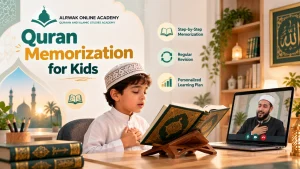

Our goal is to help families explore an approach to Quran education that fits their children’s learning needs and daily routines. In this guide, discover what children learn in Quran reading classes, how online lessons work, and how to choose the right starting point for your child.
Online Quran Reading Classes for Kids at Alrwak Academy
Alrwak Online Academy provides online Quran learning for children who want to develop their Quran reading skills from home. Lessons can be planned according to the child’s current level, helping beginners build foundational skills before moving toward more confident reading.
Instead of expecting every child to learn at the same pace, a suitable learning plan considers what the child already knows and which skills need more practice.
Quran reading lessons may focus on:
- Recognizing Arabic letters and their sounds.
- Learning Arabic vowel marks and basic reading rules.
- Connecting letters to read Arabic words.
- Practising Quranic words and verses.
- Improving pronunciation and reading accuracy.
- Building the foundation for learning Tajweed.
Parents can discuss their child’s experience and learning goals with the academy to determine the most appropriate starting point.
What Will Your Child Learn in Quran Reading Classes?
Children develop Quran reading skills gradually. A structured course should introduce foundational concepts, provide opportunities for guided practice, and revisit previous lessons to reinforce learning.
1. Learning Arabic Letters
For children who are new to Arabic, the first step is learning to recognize the letters and associate them with their correct sounds. This foundation helps children begin understanding written Arabic before progressing to more advanced reading tasks.
Repeated practice and clear pronunciation demonstrations can help children become more familiar with the letters and their sounds.
2. Understanding Vowel Marks
After learning the letters, children can begin practising basic vowel marks, including Fathah, Kasrah, and Dammah. These marks help learners understand how letters are pronounced in different combinations.
Teachers can introduce these concepts through examples and guided exercises that match the child’s current level.
3. Connecting Letters and Reading Words
Arabic letters can change shape depending on their position within a word. Children therefore need practice recognizing connected letters and reading simple combinations.
With regular instruction, learners can gradually move from recognizing individual letters to reading words and short passages more confidently.
4. Reading Quranic Verses
As children develop their foundational skills, they can begin applying what they have learned to Quranic text. The teacher listens to their reading, identifies errors, and provides corrections to support greater accuracy.
The pace should reflect the child’s ability rather than pressure them to progress before they are ready.
5. Improving Pronunciation
Correct pronunciation is an important part of Quran reading. Children benefit from hearing clear examples, repeating sounds, and receiving gentle corrections when they make mistakes.
As their reading develops, they can also begin learning relevant Tajweed rules with guidance from their teacher.
Quran Reading Classes for Beginners and Young Learners
Children start learning with different levels of Arabic knowledge. Some may already recognize the alphabet, while others may need to begin with the basics. Identifying the child’s starting level helps ensure that lessons are neither too difficult nor unnecessarily repetitive.
| Learning Level | Main Focus | Learning Goal |
|---|---|---|
| Complete beginner | Arabic letters and sounds | Recognize letters and their pronunciation |
| Early learner | Vowel marks and connected letters | Begin reading Arabic words |
| Developing reader | Reading practice and pronunciation | Read Quranic text with greater accuracy |
| More experienced reader | Fluency and introductory Tajweed | Improve recitation and develop further skills |
These levels are general examples. The teacher should assess the child’s actual reading ability before recommending a learning plan.
Why Choose Online Quran Reading Classes for Your Child?
Learn from Home
Online lessons allow children to study without travelling to a physical classroom. Parents can arrange a comfortable learning space at home and supervise their child’s participation as appropriate.
Personalized Learning
Children learn at different speeds. Individual instruction can give the teacher more opportunities to focus on a child’s pronunciation, reading mistakes, and areas that need additional practice.
Flexible Scheduling
Online learning can make it easier for families to organize Quran lessons around school, homework, and family activities. Parents should confirm the academy’s current timetable and available lesson options before registering.
Regular Practice and Feedback
Consistent practice is essential when children are developing new reading skills. Feedback from the teacher can help parents understand what their child has learned and which exercises should be reviewed between sessions.
Access to Quran Learning from Different Locations
Online classes make Quran education accessible to families who may not have a suitable local teacher nearby. With an internet connection and a compatible device, children can participate in lessons from different locations.
How to Help Your Child Succeed in Quran Reading Lessons
Parents can support their child’s learning by creating a positive routine and working with the teacher to reinforce what is covered in class.
- Set a regular schedule: Choose lesson times that fit your child’s school routine and energy levels.
- Create a quiet learning space: Reduce distractions and prepare the device before the lesson begins.
- Encourage short practice sessions: Follow the teacher’s guidance on reviewing letters, words, or verses between lessons.
- Be patient with mistakes: Reading skills develop through repetition and correction.
- Celebrate progress: Recognize effort and improvements rather than comparing your child with others.
- Communicate with the teacher: Ask for feedback and share any concerns about the child’s learning experience.
- Keep expectations realistic: Allow time for the child to develop accurate reading habits before moving to more advanced material.
At What Age Can Children Start Quran Reading Classes?
The appropriate starting age depends on the child’s readiness, attention span, and the teaching approach used in the program. Some children begin by learning Arabic letters, while others may already have basic reading skills and be ready for Quranic text.
Alrwak Online Academy accepts children starting at age five. Parents can discuss their child’s needs with the academy to understand which learning approach may be suitable.
For younger learners, a supportive teaching style and manageable lessons can help make learning more comfortable. Parents should ask how lessons are adapted to the child’s age and level before enrolling.
Quran Reading Classes vs. Quran Memorization Classes
Quran reading and Quran memorization are related but different learning goals. Understanding the difference can help parents choose the right course for their child.
| Course Type | Main Purpose | Who May Benefit? |
|---|---|---|
| Quran reading | Develop Arabic reading and pronunciation skills | Children who are beginners or want to improve reading accuracy |
| Quran memorization | Memorize selected surahs or passages and revise them regularly | Children who want to build or continue a memorization routine |
| Tajweed | Learn the rules and techniques of correct Quran recitation | Children ready to develop their recitation skills |
Some children may benefit from combining these subjects over time. The appropriate sequence depends on their current skills and learning goals.
Start Quran Reading Lessons with Alrwak Online Academy
If you are looking for Quran reading classes for kids, Alrwak Online Academy offers online Quran learning options designed for children and adults. The academy also provides learning options in Quran memorization, Tajweed, Arabic, and Islamic studies.
Children can begin from their current level, whether they are learning Arabic letters or already practising Quran reading. Parents can discuss their child’s goals and ask about suitable lessons, teacher availability, and scheduling options.
To help choose an appropriate course, consider your child’s age, Arabic reading ability, learning objectives, and the amount of time available for regular practice.
Explore Alrwak Online Academy to learn more about online Quran education and ask about the available learning options for your child.
Frequently Asked Questions About Quran Reading Classes for Kids
Can my child learn to read the Quran online from the beginning?
Yes. Children who are complete beginners can start with Arabic letters, their sounds, and basic reading concepts. Parents should choose a course that supports beginners and introduces skills gradually.
Does my child need to know Arabic before joining Quran reading classes?
No. Beginner Quran reading lessons can introduce Arabic letters and pronunciation before progressing to connected words and Quranic text. The learning plan should reflect the child’s starting level.
How often should my child attend Quran reading lessons?
The recommended frequency depends on the child’s age, learning goals, current ability, and time available for practice. Ask the teacher to suggest a schedule that balances lessons with revision at home.
How long does it take a child to learn to read the Quran?
Learning time varies according to the child’s starting level, consistency, practice, and ability to recognize and pronounce Arabic letters. A teacher can assess the child’s current skills and suggest realistic learning goals, but no fixed timeline is suitable for every child.
Are online Quran reading classes suitable for five-year-old children?
They can be suitable when lessons match the child’s readiness and attention span. Alrwak Online Academy accepts children from age five. Parents should discuss the child’s needs and the recommended lesson format with the academy.
What is the difference between Quran reading and Tajweed?
Quran reading lessons help children develop the skills needed to read Arabic and Quranic text. Tajweed focuses on the rules and techniques of correct Quran recitation. The two subjects can complement each other as the child progresses.
Can children learn Quran memorization after learning to read?
Yes. Once children have suitable reading skills, they may begin or continue memorization according to their ability and learning goals. Regular revision remains important for retaining memorized passages.
How can I choose the right online Quran course for my child?
Consider your child’s age, current reading level, learning goals, teacher’s experience, lesson format, schedule, and progress feedback. Contact the academy to discuss which course best matches your child’s needs.
Help Your Child Build a Strong Foundation in Quran Reading
Learning to read the Quran is a gradual process that begins with foundational Arabic skills and develops through regular practice, clear instruction, and appropriate correction. Choosing lessons that match your child’s level can make learning more organized and manageable.
With a suitable learning plan and encouragement at home, children can work toward more accurate reading and prepare for further Quran study, including memorization and Tajweed.
Contact Alrwak Online Academy to explore Quran reading classes for kids and discuss the right starting point for your child.
“`