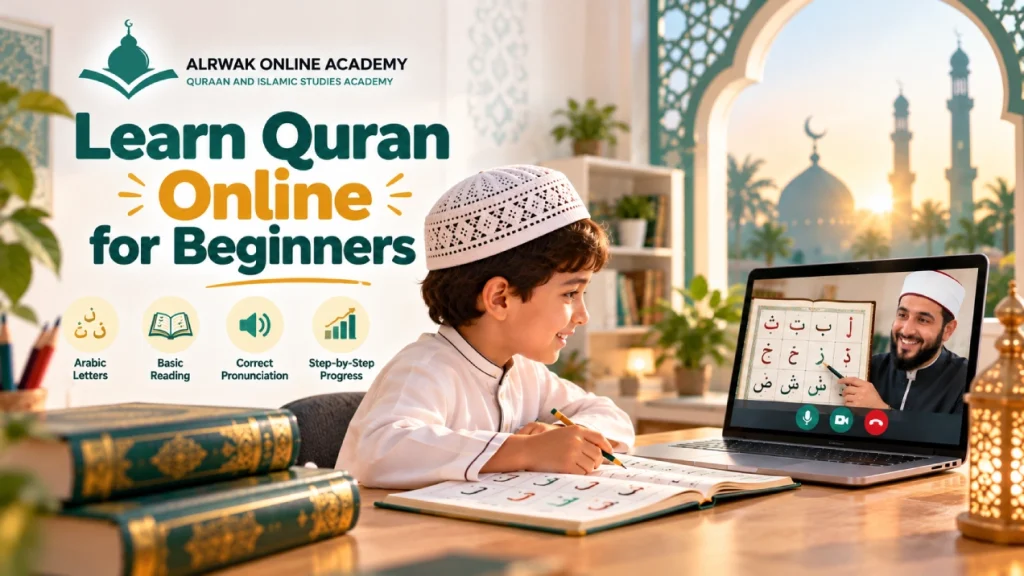
If you want to learn Quran online for beginners, the best start is a private tutor who begins exactly where you are, even if that is the first letter of the Arabic alphabet. At Alrwak Academy, beginners of every age learn in live 1-on-1 lessons on Zoom or Google Meet, explained in clear English, at a pace that suits them. Within a few months, most beginners are reading short verses from the mushaf. The first lesson is a free trial class. The program after it is paid, because every lesson is private.
What Is Our Beginners’ Program?
It is a step-by-step path that takes you from no Arabic at all to reading the Quran correctly. You learn one-to-one with a regular tutor who listens to every sound, corrects it on the spot, and explains why. There is no group to keep up with and no one watching you make mistakes, which is exactly what most beginners need.
The program is part of our wider online Quran classes, and it is the foundation for everything that follows: tajweed, memorization, and understanding.
Who Is It For?
- Adults who never learned: perhaps you grew up without access to a teacher, or never had the chance. It is not too late.
- Adults who learned a little as children and have forgotten, or were never properly corrected.
- Children starting from scratch. See our online Quran classes for kids for lessons designed around young learners.
- New Muslims who want to read the Quran and learn the prayer surahs. Our Quran classes for new Muslims are paced especially gently.
- Sisters who prefer a female tutor.
- Anyone who has tried apps or videos and found they could not tell whether they were pronouncing letters correctly.
How Live 1-on-1 Lessons Work
- Platform: Zoom or Google Meet on a laptop, tablet, or phone. A larger screen makes the Arabic text easier to see.
- Length: 30 to 60 minutes for adults, 20 to 30 minutes for children.
- Frequency: two or three lessons a week is ideal for beginners, because frequent practice builds reading faster.
- Time zones: lessons in your local time, whether you are in the UK, Europe, North America, Australia, or the Gulf.
- On screen: the tutor shares the Noorani Qaida or mushaf page and highlights each letter as you read.
- Same tutor: you keep one teacher who learns your strengths and difficulties.
Curriculum and Levels for Beginners
| Stage | What you learn | Where you are by the end |
|---|---|---|
| 1. Letters | The 28 Arabic letters, their sounds and shapes | You recognise and pronounce every letter |
| 2. Letter forms | How letters connect at the start, middle, and end of words | You can find letters inside words |
| 3. Vowels | Fathah, kasrah, dammah, tanween, and long vowels | You read syllables and short words |
| 4. Sukoon and shaddah | Silent and doubled letters | You read complete words correctly |
| 5. First verses | Reading real verses, starting with al-Fatihah and short surahs | You read short surahs slowly but correctly |
| 6. Fluency | Regular reading with basic rules of stopping | You read a page with confidence |
After this, you can continue to tajweed with our online tajweed classes, or begin memorizing with our online Quran hifz classes. We teach Hafs ‘an ‘Asim by default and award a certificate at the end of each level.
Learn to Read Quran for Beginners: What Makes It Work
People who successfully learn to read Quran as beginners usually share a few habits:
- They start with sounds, not shortcuts. Transliteration (Arabic written in English letters) feels easier at first, but it cannot capture Arabic sounds accurately. Learning the real letters from day one avoids problems later.
- They practise a little every day. Ten minutes daily is far better than an hour once a week.
- They get every mistake corrected early. That is the biggest advantage of a live tutor over apps and videos.
- They are patient with hard letters. Sounds such as ع, ح, ق, and ض have no English equivalent and take time. That is normal.
- They connect reading to prayer. Using al-Fatihah and short surahs in salah gives the effort purpose.
For a self-study overview of the method, see our guide to Quran reading for beginners, and for a closer look at our reading lessons, visit Quran reading classes online.
Your First Three Months: A Realistic Picture
| Period | Focus | Typical result |
|---|---|---|
| Month 1 | Letters, sounds, and short vowels | Recognise all letters and read simple syllables |
| Month 2 | Joining, long vowels, tanween, sukoon, shaddah | Read short words and phrases |
| Month 3 | First verses from the mushaf | Read al-Fatihah and short surahs carefully |
This assumes two or three lessons a week and a few minutes of daily practice. Some students move faster, some more slowly, and both are fine. Your tutor will set expectations after the trial class.
Common Beginner Worries
“I’m too old to learn a new script.”
Adults of every age learn to read the Quran. Adults often progress steadily because they are motivated and understand why rules work.
“I’m embarrassed about how little I know.”
Lessons are private. Your tutor teaches beginners every day, and their only goal is your progress.
“I don’t speak Arabic.”
You do not need to. Everything is explained in English, and reading the Quran does not require understanding Arabic grammar first.
“I’ve tried before and quit.”
Most people quit because the schedule did not fit or the pace was wrong. A private plan solves both.
The Hardest Letters for English Speakers, and How We Teach Them
Most beginners find the same handful of letters difficult. Knowing this in advance helps you stay patient:
| Letter | Why it is hard | How the tutor helps |
|---|---|---|
| ع (‘ayn) | Made by tightening the middle of the throat; no English equivalent | Slow practice from a gentle “ah”, with the tutor modelling the tightening |
| ح (ḥa) | A breathy sound from the middle of the throat, often confused with ه | Contrasting ح and ه side by side until the difference is clear |
| خ and غ | Sounds from the top of the throat | Comparing with sounds students may know from other languages |
| ق (qaf) | Made further back than English “k” | Showing where the back of the tongue touches |
| ص, ض, ط, ظ | “Heavy” letters with a full mouth | Pairing each with its light partner: س/ص, د/ض, ت/ط, ذ/ظ |
| ث and ذ | Tongue between the teeth, like “th” in English | Usually easy once noticed; the tutor checks they are not replaced by “s” or “z” |
These letters can take weeks to master. That is completely normal, and every fluent reader went through the same process.
Learn Quran Online for Beginners: Setting Yourself Up to Succeed
Choose a fixed time
Book lessons at the same time each week, and pick a daily practice slot. Linking it to a prayer, such as straight after Fajr or Isha, makes it easy to remember.
Prepare your space
A quiet room, headphones with a microphone, and a stable connection make lessons smoother. If you are using a phone, prop it up so your hands are free to follow the page.
Keep a small notebook
Write down each correction your tutor gives you. Reviewing that list before each lesson helps the corrections stick.
Measure progress in months, not days
Some days will feel slow. Look back after a month and compare what you can read now with where you started. The difference is usually encouraging.
What Comes After the Beginner Stage?
Once you can read confidently, you choose what to focus on next:
- Tajweed: perfecting your recitation with the full rules.
- Memorization: starting with short surahs and building a revision habit.
- Understanding: learning Quranic Arabic vocabulary and meanings.
Many students combine two of these. Your tutor will help you decide based on your goals.
Our Certified Tutors
Our tutors are skilled reciters with formal tajweed training, and many hold an ijazah with a sanad reaching back to the Prophet ﷺ. Teaching complete beginners takes particular patience and clear English, and our beginner tutors are chosen for exactly that. Male and female tutors are available.
Learn Quran Live for Beginners vs. Self-Study Apps
| Apps and videos | Live private tutor | |
|---|---|---|
| Hears your pronunciation | No | Yes, every letter |
| Corrects mistakes | No (or automated guesses) | Immediately, with explanation |
| Adapts to you | Fixed content | Fully personal |
| Keeps you consistent | Easy to stop | Regular appointments |
| Best use | Extra listening practice | Actually learning to read correctly |
Many of our students use apps for listening between lessons. That is a good combination.
Pricing and Plans
Fees depend on lesson length and the number of lessons per week. We share the full price list after your free trial class, once you have a recommended plan. There is no long contract. Only the trial class is free. The program after it is paid because it is private one-to-one teaching.
What Beginners Tell Us
Beginners often say the turning point was the first time they read a verse from the mushaf on their own. Many adults also describe a new focus in prayer once they could recite al-Fatihah correctly and understood what they were saying. For many, the biggest regret is simply not starting sooner.
Book Your Free Trial Class
- Contact us on WhatsApp or through the booking form.
- Tell us who the lessons are for, your current level (even if it is “nothing”), your time zone, and tutor preference.
- Attend the free trial class and get a recommended plan.
- Choose your schedule and start.
Only the trial class is free. The program after it is paid because it is private one-to-one teaching.
Related reading: free Quran reading level test; how to enroll.
Frequently Asked Questions
Is there a free trial class?
Yes. Your first lesson is free and includes a gentle assessment of where to begin.
How long is each lesson?
30 to 60 minutes for adults and 20 to 30 minutes for children.
Can I choose a female tutor?
Yes. Female and male tutors are available.
Which time zones do you cover?
We teach beginners across the UK, Europe, North America, Australia, and the Middle East, in their local time.
How long until I can read the Quran?
Many beginners read short verses within about three months with regular lessons and daily practice. Your tutor will give you a personal estimate.
Should I learn with transliteration?
We recommend learning the Arabic letters directly. Transliteration cannot represent many Arabic sounds accurately.
Can I learn on my phone?
Yes, although a laptop or tablet is easier because the Arabic text appears larger. If you use a phone, prop it up so your hands are free to follow the page, and use headphones with a microphone so the tutor hears you clearly.
What if I miss a lesson?
Let us know in advance and we will help you reschedule. Your tutor will review anything you missed, so you do not fall behind.
Is there homework?
Yes, but it is short: usually 10 to 15 minutes of daily reading practice.